
The pest control companies winning online are not always the largest, oldest, or most recognizable brands.
More often, they are the companies whose digital footprint makes their value easiest for customers, Google, and AI-driven search tools to verify.
That matters more than ever in 2026.
The U.S. pest control market is estimated at approximately $26.1 billion in 2025 and is projected to approach $29.1 billion to $29.3 billion by the end of 2026. Despite that size, the industry remains highly fragmented, with roughly 32,700 to 33,000 pest control companies competing across local markets.
Demand is strong. Competition is everywhere. And the companies that show up at the right moment are the ones most likely to win the call.
A Market Built on Urgency
Pest control is not a casual purchase.
A homeowner may take months to plan a renovation, compare landscaping quotes, or think through a roofing project. Pest control behaves differently.
When someone finds bed bugs in a bedroom, termites near a foundation, cockroaches in a kitchen, or rodents inside a restaurant, the search usually happens immediately.
That urgency makes pest control one of the most search-sensitive local service categories. Customers are not casually browsing. They are trying to decide who to trust quickly.
Residential services account for roughly 70% of total pest control revenue, and recurring service plans make up approximately 85% of residential service revenue. That recurring revenue is highly valuable, but the first contact often starts with an urgent search.
The opportunity is clear: appear at the moment of need, earn trust fast, and turn emergency demand into long-term customer value.
SEO Is Expanding, Not Dying
There is a common misconception that AI search, Google Maps, and zero-click results mean SEO no longer matters.
The truth is that weak SEO is simply becoming easier to ignore.
Modern search visibility for pest control companies is built from four connected layers:
- Local visibility: Google Maps and Google Business Profiles
- Organic visibility: service pages, city pages, and website content
- Trust visibility: reviews, ratings, and third-party reputation
- AI visibility: clarity for algorithms and answer engines
A pest control company does not just need to rank.
It needs to be understood.
Google needs to understand where the business operates, what pests it treats, whether it offers emergency service, how strong its reputation is, and why it should be trusted over nearby competitors.
AI tools need the same information, but with even less patience for unclear or inconsistent signals.
The Mobile Search Reality
Pest control searches are heavily mobile.
Research indicates that approximately 68% to 70% of pest control and home service inquiries originate from smartphones. That makes sense. A person who discovers a wasp nest near the front door or a mouse in the pantry is not usually sitting down at a desktop computer to research for an hour. They are pulling out the phone in their pocket.
This shortens the buyer journey.
For local smartphone searches, an estimated 76% to 88% of consumers contact or visit a business within 24 hours. In pest control, the decision window can be even tighter for emergency-driven categories like bed bugs, rodents, cockroaches, or wildlife removal.
That means the search result is often the sales floor.
If the phone number is hard to find, the Google Business Profile looks neglected, the reviews are stale, or the service page does not directly match the problem, the lead may be gone before the company ever knows it existed.
The Maps & Review Battleground
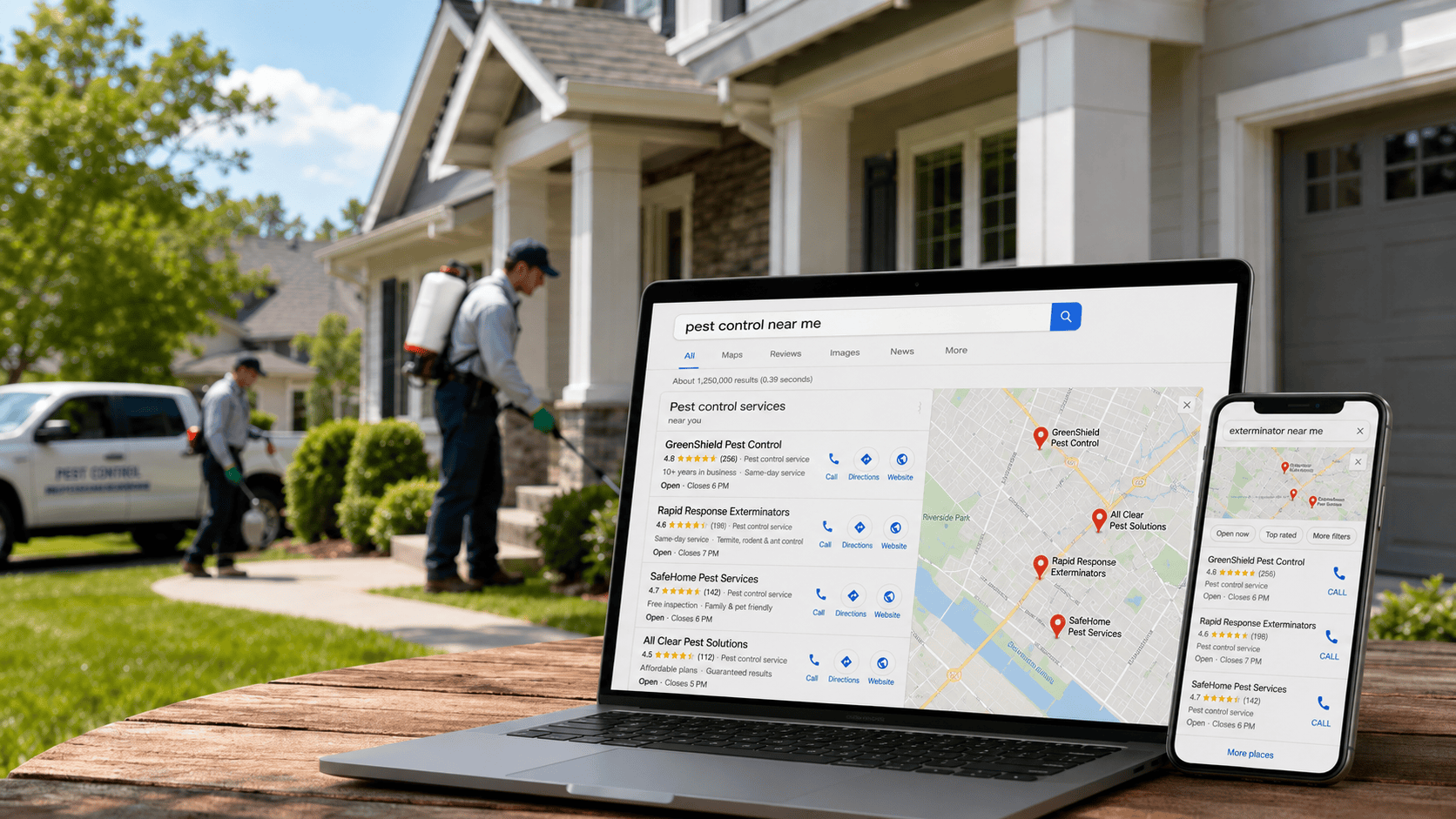
For local-intent pest control searches, the Google Maps 3-Pack is often more important than the traditional organic listings below it.
When someone searches “pest control near me,” “exterminator near me,” “termite treatment near me,” or “bed bug exterminator,” the Map Pack is usually one of the first things they see.
That placement matters because the Local Pack is estimated to capture roughly 42% of local search clicks.
A pest control company can have a decent website and still lose leads if its Google Business Profile is weaker than nearby competitors.
Google Business Profile signals may account for roughly 32% of local ranking influence, while reviews represent approximately 16% to 20%, and on-page SEO signals represent approximately 15% to 19%.
That is why Maps visibility cannot be treated as an afterthought.
A complete and active Google Business Profile, accurate service categories, current hours, strong photos, review activity, and localized service information all contribute to whether a company is visible when the customer is ready to call.
Reviews Are No Longer Optional
Pest control is a high-trust service.
Customers are allowing a technician into their home, apartment building, restaurant, warehouse, or commercial facility. They may also be worried about chemicals, pets, children, food safety, property damage, or recurring infestations.
Because of that, reviews are not just a nice-to-have. They are a filter.
Research shows that 74% of consumers disregard reviews older than three months, and 32% look specifically for reviews written within the last 14 days. Another 47% of consumers will not engage with a business that has fewer than 20 total reviews.
That creates a problem for companies relying too heavily on old reputation.
A pest control company with hundreds of older reviews can still lose trust to a competitor with fewer total reviews but stronger recent activity.
In local search, history alone does not always win.
Recent proof often does.
Zero-Click Search Changes the Strategy
Another major shift is the rise of zero-click search.
As Google adds more AI Overviews, Map results, featured answers, and direct-response elements to the search page, more users are getting what they need without clicking through to a traditional website.
The research indicates that approximately 60% of all Google searches end without a click to an external website. On mobile, that figure may rise as high as 77%.
For pest control companies, this does not mean the website is irrelevant.
It means the website has to support a broader search ecosystem.
Upper-funnel informational searches like “what do termite droppings look like” or “how do I know if I have bed bugs” may increasingly be answered directly on Google or through AI tools.
The bigger opportunity is to win the searches where the customer is ready to act:
- “bed bug exterminator near me”
- “emergency pest control open now”
- “termite inspection near me”
- “commercial rodent control for restaurants”
- “same day exterminator”
- “wildlife removal near me”
These are the searches where visibility, trust, and conversion matter most.
Different Pests Create Different Search Behavior
Pest control is not one single search market.
Different pests create different levels of urgency, fear, price sensitivity, and buyer intent.
Termites create high-anxiety searches because of the potential cost of structural damage. They are estimated to cause approximately $5 billion in annual property damage across 600,000 U.S. homes. That risk changes how customers evaluate providers. They are not only looking for the cheapest option. They are looking for inspections, treatment options, warranties, and confidence.
Bed bugs create some of the highest psychological urgency in the industry. The customer is often stressed, embarrassed, and looking for immediate help. Searchers may prioritize same-day service, heat treatment, safety, preparation instructions, and discretion.
Rodent and cockroach searches can be urgent for both residential and commercial buyers. For restaurants, property managers, and commercial facilities, these problems can create health code, reputation, and compliance risks.
Mosquito, flea, and tick searches are often more seasonal and prevention-focused. Customers may be comparing recurring plans, pet-safe treatments, yard protection, and family safety.
Wildlife removal behaves more like an emergency category. A raccoon in the attic, a bat inside the home, or an animal trapped in a wall creates immediate demand.
The mistake is treating all pest control searches the same.
A termite customer does not think like a mosquito customer. A restaurant owner with rodents does not think like a homeowner comparing seasonal yard treatments.
The website should reflect those differences.
AI Search Rewards Structured Trust
AI search is not replacing SEO.
It is raising the standard for what search engines need to understand.
Traditional searchers might type:
“pest control near me”
An AI-assisted searcher may ask:
“What is the best pest control company near me for safe bed bug heat treatment in an apartment?”
That kind of query requires more than a basic homepage.
AI tools need to understand the company’s locations, services, specialties, safety language, reviews, and third-party reputation. They need enough structured information to confidently recommend one provider over another.
Research notes that consumer use of AI tools for local business discovery has grown sharply, from approximately 6% to 45% between 2025 and 2026. Even if that figure continues to shift as consumer behavior develops, the direction is clear: more buyers are using conversational search tools to narrow their options before they ever contact a company.
For pest control companies, a stronger AI-ready footprint includes clear service pages, dedicated location pages, consistent business information, review activity, safety and licensing language, schema markup, and third-party validation.
A vague “we handle all pests” page does not give customers, Google, or AI tools enough confidence.
Specificity matters.
High-Value Search Opportunities
Many pest control companies focus almost entirely on broad terms like “pest control near me” or “exterminator.”
Those keywords are valuable, but they are also highly competitive.
The most overlooked opportunities are often specialized niches where intent is high and buyers are less price-sensitive.
Commercial restaurant pest control can represent high-value recurring revenue because the stakes are high. A pest problem in a restaurant can affect inspections, reviews, reputation, and revenue. These buyers often care about discreet service, documentation, compliance, after-hours availability, and recurring prevention.
Termite inspection and treatment can produce high-value leads because the perceived risk is serious. Customers want to know whether the company offers inspections, treatment options, warranties, and long-term protection.
Bed bug heat treatment is urgent and emotionally charged. Customers may be looking for same-day help, apartment-safe options, pet-safe language, and preparation instructions.
Recurring rodent exclusion is another strong opportunity. Many customers need sealing, prevention, and recurring monitoring, not just trapping.
Mosquito, flea, and tick prevention can also create recurring revenue when companies clearly explain plan options, seasonal timing, and safety considerations.
The easiest growth is often hiding in profitable services that competitors have not properly built search visibility around.
The Competitive Search Gap
Most pest control companies know who they compete with in the field.
Fewer know how they compare when a customer searches online and starts choosing who to call.
That gap matters.
Before a customer ever speaks to a pest control company, they may already be forming an opinion based on Google Maps visibility, review quality, website structure, service pages, and broader online reputation.
In a market with roughly 33,000 pest control companies, the winner is not always the company with the most trucks, the longest history, or the biggest service area.
It is often the company that makes trust easiest to verify at the exact moment the customer is ready to act.