
Why roofing leads are being won by the companies Google trusts most
The U.S. roofing industry is not short on demand.
It is a $92.5 billion market with more than 108,000 active roofing businesses competing for the same homeowners, property managers, commercial buildings, and storm-damage opportunities. But while the market is large, the economics are tight. Average net margins across roofing are estimated around 5.3%, while labor, materials, subcontractors, insurance, and overhead continue to pressure profitability.
That makes customer acquisition one of the most important parts of the business.
The problem is that roofing leads are becoming more expensive and more competitive to win. In many markets, high-intent roofing clicks can cost $30 to $70 per click through paid search. That is not per lead. That is per click.
So the real question for roofing companies in 2026 is not whether people need roofers.
They do.
The question is whether they are finding your company when they search — or whether competitors are capturing those calls through stronger Google Maps visibility, fresher reviews, better service pages, and clearer trust signals.
SEO is not dead. But weak SEO is becoming easier to ignore.
Roofing search is urgent, local, and high-value
Roofing is one of the strongest local search categories because the customer’s problem is usually serious.
Someone searching “roof repair near me,” “emergency roofer,” “hail damage roof inspection,” or “commercial flat roof repair” is rarely just browsing. They may have water coming into the home, visible storm damage, an aging roof, an insurance claim, or a commercial property issue that needs attention quickly.
These are high-intent searches.
Across home services, more than 56% of consumers use mobile phones as their primary way to discover service providers. For urgent roofing searches, that mobile share can be even higher because the homeowner is usually looking for immediate help. Local mobile behavior matters because 78% of local mobile searches lead to an offline purchase or engagement within 24 hours.
That means a roofing search on a phone is often the moment right before a call.
If your website loads slowly, hides the phone number, lacks reviews, buries emergency service information, or does not clearly explain your service area, the customer may never make it to your quote form.
They will call someone else.
Google Maps is now one of the biggest battlegrounds
Many roofing companies still think SEO is only about ranking a website.
It is not.
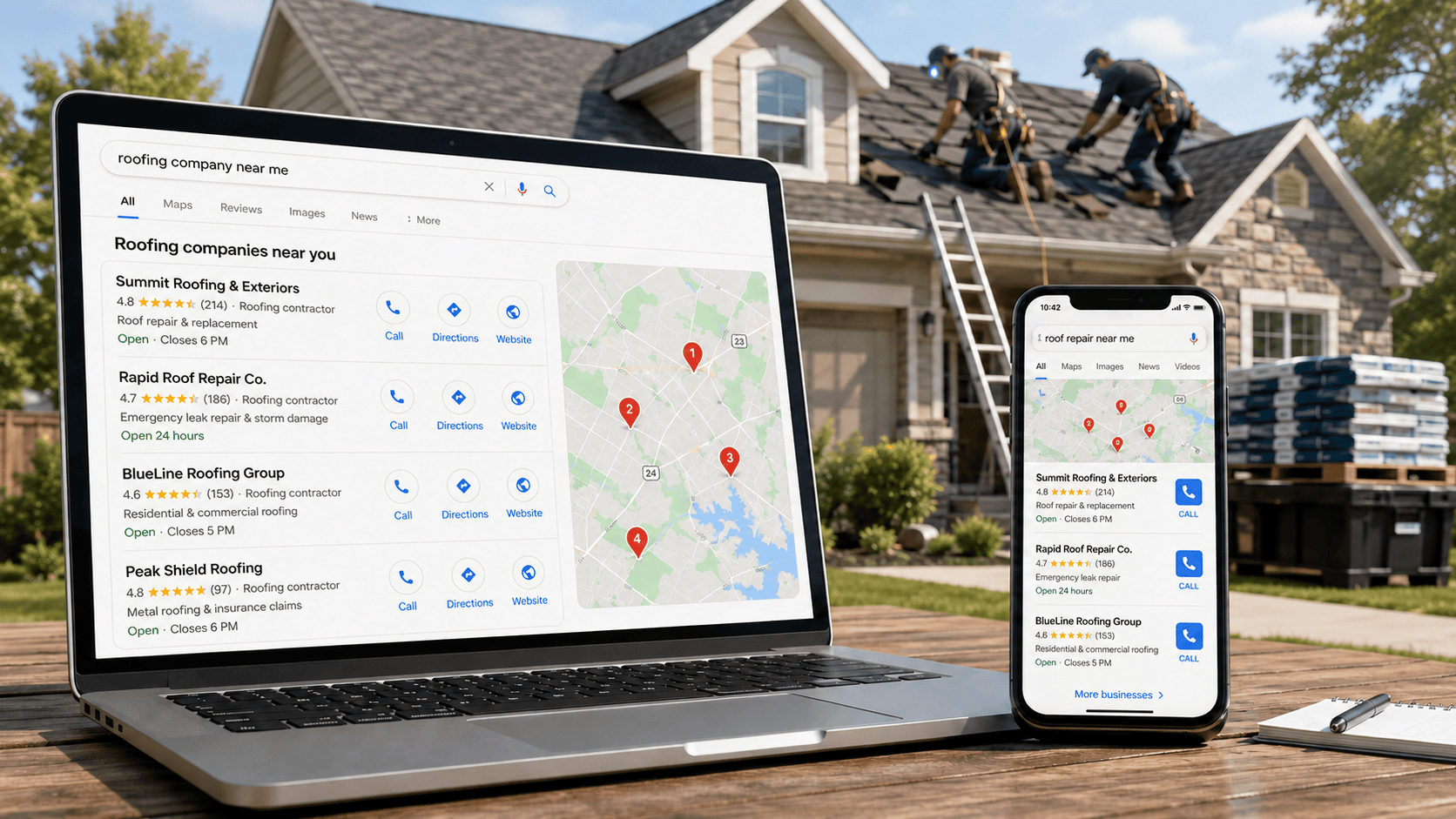
For local searches, the Google Maps 3-Pack is often where the decision starts. The Local Pack appears in more than 93% of searches with local intent and absorbs roughly 44% of clicks on those searches.
That matters for searches like:
“roof repair near me”
“best roofing company in [city]”
“emergency roofer near me”
“hail damage roof inspection [city]”
“commercial roofing contractor near me”
A roofing company can have a decent website and still lose leads if its Google Business Profile is weaker than competitors.
Maps visibility is influenced by factors like category selection, proximity, review volume, review velocity, service listings, business hours, project photos, and the quality of the website page connected to the profile.
For roofers, the Google Business Profile is not just a directory listing.
It is a lead-generation asset.
Reviews are no longer just social proof
Roofing is a high-trust purchase.
A bad roofing decision can cost a homeowner thousands of dollars. It can create leaks, insurance issues, warranty problems, and property damage. Because of that, customers filter roofers aggressively before they ever call.
The review benchmarks are steep:
31% of consumers require at least a 4.5-star rating before considering a business.
87% of consumers reject businesses with less than a 4-star average.
47% of consumers will not use a business with fewer than 20 reviews.
74% of consumers only consider reviews from the past three months relevant.
That last point is critical.
A roofing company may have done great work for years, but if the review profile is stale, buyers may not feel the same confidence. Recent reviews prove the company is active, reliable, and completing quality work now.
A competitor with fresher reviews, better responses, and stronger project photos may win the call even if they are not the better roofer.
They are simply doing a better job proving trust online.
AI search is changing SEO, not replacing it
Google AI Overviews, ChatGPT, Gemini, and Perplexity are changing how people search.
But they have not made SEO irrelevant.
They have made strong SEO more important.
AI systems need clear, structured, trustworthy information before they can confidently mention or recommend a business. A vague roofing website with one generic services page gives search engines very little to work with.
For roofing companies, AI and search visibility depend on signals like:
Dedicated service pages.
City and service-area pages.
Google Business Profile strength.
Recent reviews.
Project photos.
Manufacturer certifications.
Warranty information.
Insurance-claim support.
Financing details.
Commercial roofing pages.
Storm damage and emergency repair pages.
Structured data and consistent business information.
The companies most likely to benefit from AI search are not necessarily the biggest companies. They are the ones with the clearest, most verifiable digital footprint.
The biggest opportunities are not always the biggest keywords
Most roofing companies chase the obvious terms:
“roofing company”
“roofer near me”
“roof repair”
“roof replacement”
Those terms matter, but they are also highly competitive.
The better opportunities are often more specific, more urgent, and more profitable.
Emergency roof repair
Searches like “emergency roof leak repair near me” or “24 hour roof repair” often come from homeowners who need immediate help. These pages need clear response-time language, click-to-call visibility, emergency availability, and strong reviews.
Storm and hail damage
Searches like “hail damage roof inspection [city]” or “storm damage roof repair near me” can produce high-value jobs, especially when insurance claims are involved. These pages should explain inspections, documentation, storm response, and insurance-related next steps.
Commercial flat roofing
Searches like “commercial flat roof repair [city]” or “TPO roofing contractor near me” often come from property managers and facility directors. These buyers need proof of commercial experience, safety, maintenance plans, material expertise, and case studies.
Metal roofing
Searches like “metal roofing contractor [city]” or “metal roof replacement cost” attract higher-ticket, research-driven buyers. These pages should include warranty details, financing, manufacturer certifications, energy-efficiency information, and project examples.
Insurance-claim roofing
Searches like “roof inspection for insurance claim” or “roof replacement insurance claim help” come from homeowners who are financially motivated but unsure about the process. Clear education can turn confusion into a lead.
The mistake many roofing companies make is trying to win only the broadest keywords.
The better question is:
Which high-value services do you offer that competitors have not properly built search visibility around yet?
What this means for roofing companies
The roofing companies winning search in 2026 are not relying on one generic website page.
They are building digital proof around their most valuable services.
That means:
A strong Google Business Profile.
Fresh reviews.
Real project photos.
Dedicated roof repair and roof replacement pages.
Storm damage and hail damage pages.
Commercial roofing pages.
Metal roofing and flat roofing pages.
Insurance-claim support content.
City and service-area pages.
Fast mobile experience.
Clear calls to action.
Strong trust signals.
The goal is not just to “get more traffic.”
The goal is to show up when the right buyer is searching, prove trust quickly, and convert that search into a call, inspection, or estimate request.
In a market with more than 108,000 roofing businesses, visibility is not automatic.
It has to be built.